

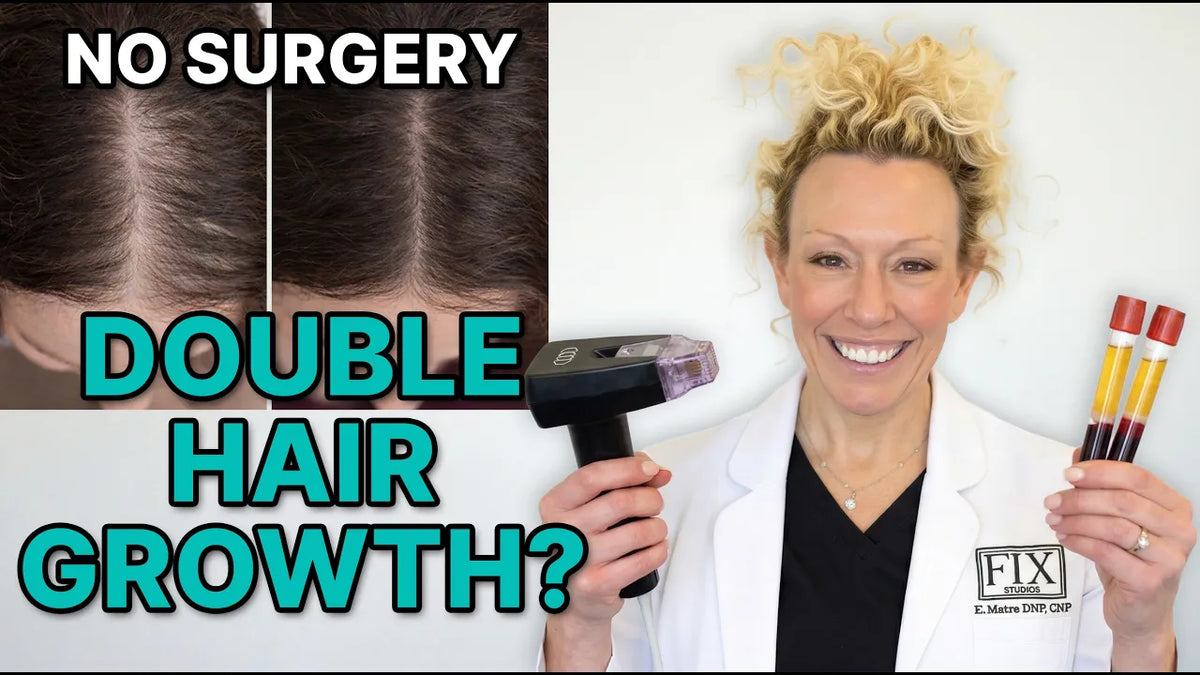
Thinning hair can have many causes, which means hair restoration shouldn't start with a one-size-fits-all treatment.
For some men and women with appropriate types of hair thinning, combining PRP or PRF with Morpheus8 RF microneedling may provide a more comprehensive approach than relying on one treatment alone.
In this episode of Skin Strategy with Dr. Beth, Dr. Beth Matre explains how platelet-based treatments and RF microneedling work on the scalp, who may benefit, and when this combination may not be the right choice.
What You'll Learn About Hair Restoration
✅ How PRP and PRF are used for non-surgical hair restoration
✅ How Morpheus8 RF microneedling works when used on the scalp
✅ Why combining treatment approaches may offer advantages over using one modality alone
✅ Why hair thinning affects both men and women
✅ Which types of thinning may respond better to regenerative treatments
✅ When PRP, PRF, or Morpheus8 may not be appropriate
✅ What treatment day and recovery can look like
✅ How Fix Studios approaches Morpheus8 hair restoration protocols
✅ Why hair restoration results take time and require realistic expectations
How Do PRP and PRF Work for Hair Restoration?
PRP, or platelet-rich plasma, and PRF, or platelet-rich fibrin, use components derived from your own blood.
The goal is to concentrate platelet-related growth factors and introduce them into targeted areas of the scalp.
These treatments are commonly discussed for people experiencing certain forms of hair thinning, including patterned hair loss.
PRP and PRF don't create new hair follicles.
Instead, the goal is to support existing follicles that are still capable of producing hair.
That distinction matters.
Hair restoration treatments generally have a better chance of helping when follicles are still present but producing thinner, weaker hairs.
What's the Difference Between PRP and PRF for Hair?
Both PRP and PRF are created from a patient's own blood, but they are processed differently.
Dr. Beth explains how these platelet-based treatments can be incorporated into a regenerative hair restoration plan.
The most important question isn't simply whether PRP or PRF is "better."
It's whether the treatment is appropriate for your type of hair loss, the condition of your follicles, and your overall medical history.
How Does Morpheus8 Work for Hair Restoration?
Morpheus8 is best known as an RF microneedling treatment for the skin, but RF microneedling can also be used on the scalp.
RF microneedling combines controlled microneedling with radiofrequency energy.
When used for hair restoration, the goal is to create a controlled treatment environment in the scalp that may support regenerative processes around existing hair follicles.
This is different from simply injecting PRP or PRF.
That's why combining the approaches may make sense in selected patients.
One component provides platelet-derived material, while the other uses controlled RF microneedling stimulation.
Why Combine PRP or PRF With Morpheus8?
This is one of the most important questions Dr. Beth answers in the video.
PRP or PRF and RF microneedling work through different mechanisms.
Rather than asking one treatment to do everything, combining them may allow a provider to address the scalp from more than one angle.
Dr. Beth discusses research suggesting that combination approaches may outperform a single treatment in selected patients.
The important word is may.
Hair restoration results vary, and no responsible provider should promise a specific amount of regrowth.
The success of treatment depends on the cause of hair loss, how advanced the thinning is, whether viable follicles remain, and how consistently the treatment protocol is followed.
Does Hair Restoration Work for Women Too?
Yes. Hair thinning isn't only a men's issue.
Women may notice:
- A widening part
- Reduced density through the top of the scalp
- Increased shedding
- Thinning around the temples
- A smaller ponytail
- More visible scalp
Female pattern hair loss can look different from male pattern hair loss, which is one reason proper evaluation matters.
Dr. Beth discusses why regenerative hair treatments can be considered for both men and women when the underlying type of thinning is appropriate.
Who Is a Good Candidate for PRP, PRF and Morpheus8 Hair Restoration?
The best candidates generally still have active hair follicles that have become thinner or less productive.
That may include people noticing gradual patterned thinning rather than complete loss in an area.
Examples can include:
- A widening part
- Crown thinning
- Temple recession
- Reduced overall density
- Early patterned hair loss
The goal is to support follicles that are still capable of responding.
This is why starting earlier can be different from treating an area where follicles are no longer functioning.
When Is This Not the Right Hair-Loss Treatment?
Not every type of hair loss should be treated with PRP, PRF, or RF microneedling.
Hair loss can be related to many factors, including:
- Genetics
- Hormonal changes
- Nutritional issues
- Medical conditions
- Medications
- Stress-related shedding
- Scalp disorders
- Autoimmune conditions
If the underlying cause isn't understood, immediately choosing a cosmetic hair restoration treatment may miss the real problem.
Some types of hair loss require medical evaluation or a different treatment strategy.
That's why Dr. Beth emphasizes history, scalp evaluation, and appropriate patient selection before recommending treatment.
What Happens During a Hair Restoration Treatment?
For a platelet-based treatment, blood is drawn and processed to prepare the PRP or PRF.
The platelet-rich material is then used in targeted areas of the scalp.
When Morpheus8 is incorporated, RF microneedling is performed according to the treatment plan and appropriate scalp settings.
Because this is a medical procedure, treatment parameters matter.
Device settings, treatment depth, patient selection, scalp anatomy, and provider experience all affect how the treatment should be performed.
How Long Does Hair Restoration Take to Work?
Hair restoration isn't immediate.
Hair follicles operate on growth cycles, so meaningful changes take time.
Patients shouldn't expect to leave treatment and see new density a week later.
Dr. Beth discusses the protocol and timeline used at Fix Studios and why treatment is evaluated over a period of months rather than days.
The goal is gradual improvement in areas where follicles can still respond.
Progress may involve changes such as:
- Reduced appearance of thinning
- Improved density
- Fuller-looking hair
- Improvement in the appearance of the part or crown
Individual results vary.
Is PRP Alone Enough for Hair Restoration?
It can be useful for some patients, but that doesn't mean it is automatically the best approach for everyone.
PRP and PRF have been studied for patterned hair loss.
Microneedling has also been studied as part of hair-loss treatment strategies.
RF microneedling represents another approach.
The reason Dr. Beth discusses combining treatments is that they don't all work in exactly the same way.
For an appropriate candidate, a multimodal approach may make more sense than expecting one treatment to solve every aspect of thinning hair.
Can Morpheus8 Regrow Hair?
It's better to think of Morpheus8 as a hair restoration treatment option, not as a guarantee of hair regrowth.
RF microneedling may support an environment that helps appropriate existing follicles.
It cannot guarantee that inactive or absent follicles will begin producing hair again.
That distinction is especially important for anyone comparing non-surgical treatments with hair transplantation.
A hair transplant physically relocates follicles.
PRP, PRF, microneedling, and RF microneedling aim to support follicles that are already present.
Those are fundamentally different approaches.
PRP, PRF and Morpheus8 Hair Restoration in Cincinnati
At Fix Studios in Mason, Ohio, Dr. Beth Matre uses a medically guided approach to hair restoration.
For patients from Mason and Greater Cincinnati experiencing thinning hair, widening parts, crown thinning, or temple recession, the first step is determining whether regenerative hair restoration makes sense for the type of hair loss involved.
Depending on the patient, treatment may include PRP, PRF, Morpheus8 RF microneedling, or a combination approach.
The goal isn't to promise overnight hair growth.
It's to identify whether viable follicles remain and select a treatment strategy designed around the patient's actual pattern of thinning.
Schedule a consultation with Dr. Beth and Fix Studios
Chapters
0:00 — Thinning Hair? There's a Better Combo
0:38 — Dr. Beth Intro
0:49 — What This Video Covers
1:47 — Brief Hair-Loss Overview
2:27 — Why Many People Don't Want to Rely Only on Medications
3:03 — Hair Regeneration Treatments for Those Who Don't Want Medications
3:41 — How PRP and PRF Work
5:19 — Why This Matters for Women Too
6:03 — How Morpheus8 Works on the Scalp
7:19 — Why the Combination Works So Well
9:55 — “Nearly Double” Hair Growth Without Overpromising
10:35 — Best Candidates
11:11 — When This Is Not the Right Treatment
11:40 — What Treatment Day Looks Like
12:47 — Protocol and Timeline
14:07 — Final Takeaway
14:47 — Outro + Next Step
About Dr. Beth
Dr. Beth Matre is a Doctor of Nursing Practice and Certified Nurse Practitioner with more than a decade of experience in aesthetics and wellness.
Her clinical background also includes more than two decades of experience spanning Critical Care, ER/Trauma, Dermatology, and Urgent Care.
At Fix Studios in Mason, Ohio, Dr. Beth combines medical precision with practical, evidence-informed education to help patients understand their hair restoration options.
Fix Studios serves Mason and the Greater Cincinnati area with a warm, no-pressure approach focused on personalized care and realistic expectations.
Hair loss has many possible causes. This video and article are educational and aren't personal medical advice. Appropriate treatment depends on your medical history, scalp evaluation, pattern of hair loss, and individual goals.



Share:
Botox Alternative That Gives Better Results? Here's What Works
Dull Skin After 35? This Is What's Actually Happening